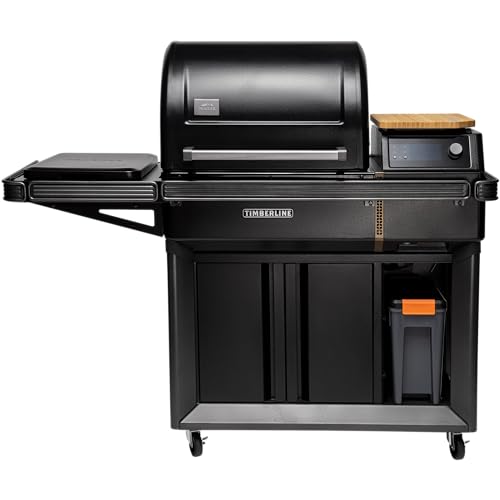
The Traeger Timberline is the top of the Traeger lineup on this site, and the first grill in our ranking. It combines a large pellet-fired cooking chamber with a side induction cooktop, a touchscreen controller and Wi-Fi control, wrapped in a fully insulated body. Everything below comes from Traeger’s own product page for the standard Timberline. We do not cook on these grills ourselves, so we cannot tell you how evenly it heats or how quickly it recovers after the lid is opened. What we can do is lay out the published specs and explain who each feature is for. If you want the full ranking first, see our pellet grill comparison.
Key Specs According to Traeger
- Cooking space: 880 sq in across three tiers of stainless-steel grates. Traeger lists the racks at 396, 242 and 242 sq in.
- Capacity chart: 9 chickens, or 8 rib racks, or 6 pork butts.
- Temperature range: 165°F to 500°F.
- Hopper: 22 lb of pellets, with a hopper clean-out so you can switch pellet flavors.
- Power: 120V AC and 1,756 watts, with a 6 ft power cord included. Traeger tells you to plug it into the nearest outlet.
- Connectivity: WiFIRE, controlled from the Traeger App, plus an integrated pellet sensor that shows your pellet level in the app.
- Included thermometers: two Traeger X MEATER wireless meat thermometers and two wired meat probes.
- Warranty: 10-year limited warranty.
Traeger’s page also lists a weight figure of 238 in its spec chart but does not print a unit next to it, so we are not repeating it as pounds. Check the weight on the box or the manual if you need to plan a delivery or a deck.
What Makes the Timberline Different: The Induction Cooktop
Most pellet grills do one job, which is to burn pellets and hold a temperature. The Timberline adds a side Traeger Induction cooktop, which Traeger describes as being for scorching-hot searing, sauteing, simmering, frying and more. In practice that means you can run a pot of beans or a cast iron skillet on the side while a brisket is in the main chamber, without carrying anything back into the kitchen. Traeger sells a cast iron skillet designed for the induction surface.
Whether that is worth it depends on how you cook. If your outdoor meals are mostly smoked meat, the side cooktop is an extra you may use rarely. If you cook full meals outside, finishing a steak with a hard sear on the induction surface or building a pan sauce while the meat rests, it removes a trip indoors. It is also an electric feature, so it adds to the grill’s power draw. Traeger lists 1,756 watts for the grill, a far higher figure than the 218 watts it gives for the Ironwood, which is worth knowing if you plan to run the grill from a shared circuit or a generator. Ask a licensed electrician if you are unsure about outlet capacity.
Cooking Space and Layout
At 880 sq in the Timberline is mid-sized by pellet grill standards and sits between the smaller 616 sq in Ironwood and the 972 sq in Weber Searwood XL 600 in our ranking. Its three-tier design is the interesting part. Traeger says the grates are stainless steel, and the third tier lets you stack food vertically when you are cooking for a group: ribs on one rack, wings on another, vegetables on a third.
Traeger’s own FAQ makes one practical point about the layout. If you are cooking low and slow, it suggests putting food on the upper racks for best results. For searing, Traeger says the main cooking grates hold high temperatures well enough to produce a crust, and that the induction cooktop is also good for searing. That is Traeger’s claim, not something we verified.
If you regularly cook for more than eight to ten people, or you want two or three whole pork butts at once, check the capacity chart carefully. Six pork butts is Traeger’s number for the Timberline; the Woodridge Pro we list claims eight pork butts, so the Timberline’s extra money is not buying more raw capacity. It is buying features.
Temperature Range and Smoke
Traeger lists a range of 165°F to 500°F. Traeger describes Super Smoke Mode, which cranks up smoke flavor, and Smart Combustion technology, which it says maintains consistent cooking temperatures. It also lists Traeger Downdraft Exhaust, which it says keeps fresh smoke flowing over the food. The body is dual-wall and fully insulated, which Traeger says reduces temperature fluctuation when the weather turns cold.
Traeger’s FAQ adds a useful note about smoke: higher temperatures produce less smoke, and food cooked between 165°F and 225°F picks up more smoky flavor. So if smoke is your priority, use the low end of the range and Super Smoke Mode. If you want high-heat searing on the main grate, remember that the Timberline stops at 500°F, while the Weber Searwood grills in our comparison list 600°F.
Controls, App and Cleanup
The Timberline has a touchscreen display and WiFIRE. With the Traeger App you can watch and change the cook from your phone, and the grill receives over-the-air software updates. Traeger’s FAQ says you can use the grill without being connected to the internet, but it recommends staying connected for those updates and for remote control.
For cleanup, Traeger lists the EZ-Clean Grease and Ash Keg, which collects drippings and pellet ash in one container. Grease and ash cleanup is the least glamorous part of pellet grill ownership, and a single keg is easier than separate pans.
The accessory system is worth a look if you like customizing. Traeger’s P.A.L. Pop-And-Lock rail takes shelves, hooks, storage bins and a roll rack, and ModiFIRE accessories sit on the grates. The grill also includes a removable magnetic bamboo cutting board and an internal cook light for night cooking.
Placement and Safety
Pellet grills burn wood and produce carbon monoxide, so they are for outdoor use only. Traeger’s own manuals for the Ironwood and the Woodridge give a minimum of 20 inches from the grill to nearby combustibles and say never to use the grill in an enclosed area or under a combustible ceiling or overhang. For the Timberline, follow the clearance printed in its owner’s manual, which you can download from Traeger’s product page. The Seattle Fire Department advises using a grill only outdoors on a noncombustible surface, 10 feet away from siding, deck rails and open doors or windows, and keeping a three-foot kid and pet zone around it. The International Fire Code generally prohibits grills on combustible balconies or within 10 feet of combustible construction, with exceptions, so check your local fire code, HOA or condo rules before placing a grill on a deck or balcony. Never run any pellet grill inside a garage, tent or camper. None of this guarantees safety, but it is the baseline.
Who Should Buy the Timberline
- You want a premium pellet grill and also want a side burner or induction surface for sides, sauces and searing.
- You like app control, pellet-level alerts and over-the-air updates.
- You plan to build the grill into an outdoor kitchen; Traeger says it can be permanently built in.
- You cook for 4 to 10 people and want three tiers of grate space.
Who Should Look Elsewhere
- Buyers who want the most cooking space. The Traeger Woodridge Pro lists 970 sq in and a 24 lb hopper in the mid-range class.
- Buyers who want a premium pellet grill without the induction cooktop. The Traeger Ironwood has the same 165°F to 500°F range, WiFIRE and 22 lb hopper in a smaller 616 sq in body.
- Anyone who wants 600°F searing from the main grate. Look at the Weber Searwood models in our ranking.
- Tailgating or camping. This is a full-size stationary grill, not a portable.
Bottom Line
The Traeger Timberline is the most feature-rich grill in our lineup: three tiers, an induction side cooktop, a touchscreen, WiFIRE, two wireless thermometers and a 10-year limited warranty, all according to Traeger. Its limits are the 500°F ceiling and its premium position. If the side cooktop and the build-in option matter to you, it earns its place at number one. If they do not, the Ironwood or Woodridge Pro will cook just as much food for less.
See price on Amazon
Compare it with every other grill we picked in our ranked pellet grill comparison.
Sources