We earn a commission if you buy through our links, at no extra cost to you.
Best Pellet Grill for RV, Camper & Tailgating
Pellet grill for an RV, travel trailer or tailgate: storage bay fit, lifting weight, shore power vs. inverter, awning and slide-out clearance, venue rules.
At a glance
For an RV or truck tailgate, the Traeger Ranger is the easiest to stow at 60 lbs with a tabletop design. The Traeger Tailgater adds 300 sq in and folding legs at 62 lbs, and the Grilla Chimp 2.0 has 460 sq in for crowds but weighs 90 lbs. All need a 120V outlet or inverter.
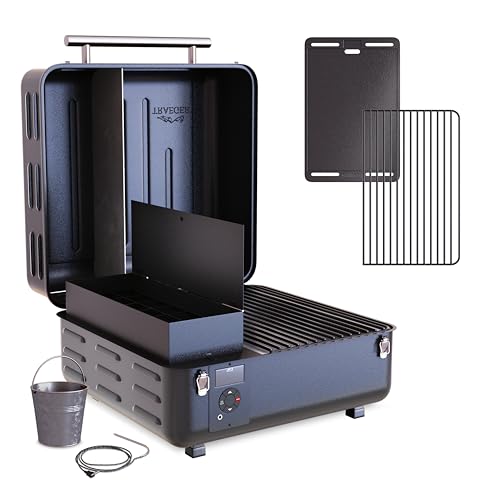
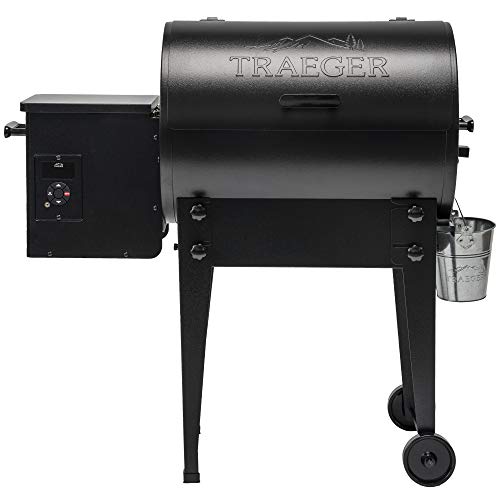

An RV owner and a football tailgater both want a pellet grill that travels, but they have different problems. The RV owner has a fixed amount of storage bay and a rig full of things that can catch fire. The tailgater has a truck bed, a parking lot and a stadium’s rules. This guide splits the choice by vehicle instead of by trip, so you can go straight to your own setup. If you are packing a tent and a cooler, our camping guide is the better read.
We do not handle these grills. Specifications come from the makers’ own product pages, and fire-safety points come from the Seattle Fire Department, the International Code Council and Traeger’s owner’s manuals.
Three Numbers That Decide Everything
Before you look at vehicles, compare the three portables on the numbers that matter when you are lifting and stowing:
| Grill | Weight | Cooking area | Hopper | Legs or tabletop |
|---|---|---|---|---|
| Traeger Ranger | 60 lbs | 176 sq in | 8 lbs | Tabletop |
| Traeger Tailgater | 62 lbs | 300 sq in | 8 lbs | Easy-fold legs |
| Grilla Chimp 2.0 | 90 lbs | 460 sq in | 15 lbs | Snap-lock folding legs, wheels |
Two of them are within 2 lbs of each other. The Chimp 2.0 is 28 to 30 lbs heavier. If you have a bad back or you are lifting into an elevated storage bay, that difference is the main reason to choose.
If You Own a Motorhome or Travel Trailer
Stowing It in a Basement Bay
Measure the bay opening before you think about the grill. Traeger does not list outside dimensions on the pages we read, and Grilla lists two different sets for the Chimp, either 41 by 38 by 20 inches or 39 by 40 by 22 inches. That mismatch is a reason to read the manual and measure the real grill, folded, before you buy. For a typical bay, the Ranger’s tabletop shape is easier to slide in and out than a grill with folded legs.
Power: Shore Power or an Inverter
At a campsite with hookups, run the grill from an exterior 120V outlet or a short extension cord. Traeger lists 120V AC and 250 watts for the Ranger and Tailgater, with a 6 ft cord. Grilla lists a standard household three-prong 120 volt outlet.
Away from hookups, you are depending on a generator or an inverter. Check the inverter’s continuous rating and the grill’s start-up needs, and ask the maker if the manual does not list them. We do not publish the Grilla’s wattage because Grilla’s page does not list one in the text we read.
Where the Grill Sits Relative to the Rig
This is the most important RV-specific rule. Traeger’s owner’s manual for the Ironwood and Woodridge says never to use the grill in an enclosed area and not to install or operate it under a combustible ceiling or overhang. It lists a minimum distance of 20 inches from the grill to nearby combustibles, including siding, wooden railings and furniture. Those figures are from the manuals of the larger grills, so for the portables follow the clearance listed in your owner’s manual.
For an RV, that has practical consequences:
- Awnings: do not cook under an extended awning, even for a short time.
- Slide-outs and siding: keep the grill well away from slide-out rooms and trailer siding.
- Neighbors: at crowded parks, the next rig may be closer than 10 feet. Seattle Fire Department advises grilling 10 feet from siding, deck rails and open doors or windows. Place the grill so the smoke and heat do not reach neighboring rigs.
- Cooling and stowing: let the grill cool completely before you load it.
The Pick for RVs: Traeger Ranger
A 60 lb tabletop pellet grill with 176 sq in and an included cast iron griddle. Fits a couple's RV and a tight storage bay.
The Ranger is our lead pick for an RV because it is the smallest and lightest of the three, and because it is simple. It has a Digital Arc controller, a Keep Warm mode, an 8 lb hopper and no app to configure. Traeger rates the grate at one rib rack or six burgers. That suits two people and a short stop, not a crowd. The full details are in the Traeger Ranger profile.
If You Tailgate From a Pickup or SUV
Loading, Lifting and Setting Up
A truck bed or hatch changes the math. You lift the grill up to waist or chest height, set it down, and do it again at the end of the day with a hot firebox. Lift the weight with a helper, and never carry a hot grill. The Tailgater’s 62 lbs is a two-handed job; the Chimp’s 90 lbs is a two-person job, though Grilla says it can roll out on its wheels.
Where to Set It Up
A tailgate or a tabletop is not a stable base for every grill. The Ranger is designed for a tabletop. The Tailgater and Chimp fold their legs and stand on the ground, so pick a flat, noncombustible spot, a few feet from the vehicle, and keep the kid and pet zone Seattle Fire Department suggests, three feet around the grill. Do not set up under a vehicle’s open hatch or a pop-up canopy; that is our editorial advice, and the manual’s warning about combustible overhangs applies.
Power in a Parking Lot
Most stadium lots have no outlets. That leaves a portable power station, a generator, or an inverter on the vehicle. Grilla lists a power station hanger on the Chimp 2.0 and sells a bundle with its own power station. For the Traeger grills, compare the 250 watt draw with the supply’s rating. Confirm that your device can run a resistive heater and a fan motor, and check the maker’s guidance.
Venue Rules
Stadiums, fairgrounds and public lots set their own limits. Some prohibit open flame, some limit grill size or fuel type, and some require a permit. Check the venue’s website, and ask staff if you are unsure. Local fire code also applies to the lot, and the International Fire Code limits open-flame cooking within 10 feet of combustible construction, with exceptions.
The Pick for a Pickup Tailgate: Traeger Tailgater
A 62 lb portable with 300 sq in and easy-fold legs. Fits a family tailgate that needs more room than a tabletop grill.
Traeger rates the Tailgater at two chickens, three rib racks or twelve burgers, with a smoke setting up to 450°F and an 8 lb hopper. It has no WiFIRE. Traeger says it is built for balconies, tailgating and anywhere else you want to take its versatility. It is the middle choice here: more food than the Ranger and 28 lbs less to lift than the Chimp. See the Traeger Tailgater profile.
If You Cook for a Big Tailgate Crowd
The Pick for Large Groups: Grilla Chimp 2.0
A 90 lb portable with 460 sq in, a 15 lb hopper and a hook for a power station. Fits a big tailgate with a helper for loading.
If your tailgate feeds eight people, cook space matters more than weight. Grilla lists 460 square inches, a 15 lb hopper, and says it rolls out and stands on its own. The Chimp also has Grilla’s Alpha Connect 2.0 Wi-Fi controller with timers and two probes. That is a lot of capability for a portable. It is also the heaviest, so plan for two people and a way to get it up to the truck bed. Details are in the Grilla Chimp 2.0 profile.
Which One for Your Rig?
| Your setup | Our pick | Why |
|---|---|---|
| Motorhome or trailer with a small bay | Traeger Ranger | Lightest and most compact |
| Pickup or SUV, family of four | Traeger Tailgater | 300 sq in at 62 lbs, with folding legs |
| Large group, two people to lift | Grilla Chimp 2.0 | 460 sq in and a 15 lb hopper |
If your grill will stay on a patio most of the time and travel only occasionally, a full-size model is probably a better buy. Our pellet grill ranking for 2026 compares every grill on this site, and the Weber Searwood 600 profile covers a mid-range stationary option.
Sources
- Traeger Ranger, official product page
- Traeger Tailgater, official product page
- Grilla Grills Chimp 2.0 Tailgater Wood Pellet Grill, official product page
- Ironwood owner’s manual (TFB93RLG)
- Woodridge owner’s manual (TFB86MLH)
- Seattle Fire Department: Outdoor Grilling and Fire Safety
- International Code Council: Avoid burns and trauma this summer
Frequently asked questions
Can I use a pellet grill under my RV awning?
Traeger's owner's manual for the Ironwood and Woodridge says not to install or operate the grill indoors or under a combustible ceiling or overhang. An RV awning is an overhang, and a camper's side is combustible construction, so set the grill out in the open and follow the manual for your model. This is also our own editorial advice.
Do I need shore power to run a pellet grill at an RV site?
You need a 120V source. Traeger lists 120V AC and 250 watts for the Ranger and Tailgater, and Grilla lists a standard household 120 volt outlet for the Chimp 2.0. At a full-hookup site that can be an exterior outlet or an extension cord within reach. Away from hookups, use a generator or an inverter that can supply the load, following the maker's guidance.
How much do these grills weigh?
Traeger lists 60 lbs for the Ranger and 62 lbs for the Tailgater. Grilla lists 90 lbs for the Chimp 2.0. These are the grills' own weights, not including pellets.
Can I cook at a stadium tailgate with a pellet grill?
Rules differ by venue and by lot. Some lots limit or prohibit open-flame cooking, or require a specific distance between vehicles. Check the venue's website or ask the staff, and bring a power source if the lot has no outlets.
Is a tabletop pellet grill better than one with legs for an RV?
For storage, the tabletop Ranger is the most compact. For cooking, the Tailgater and Chimp 2.0 fold their legs and stand at working height. The Ranger needs a sturdy table or tailgate, while the others need level ground.
Can I run the grill while the RV is moving or parked in a garage?
No. A pellet grill is an outdoor appliance. Let it cool completely before you stow it, and never run it inside an RV, a trailer or a garage, where burning pellets produce carbon monoxide.