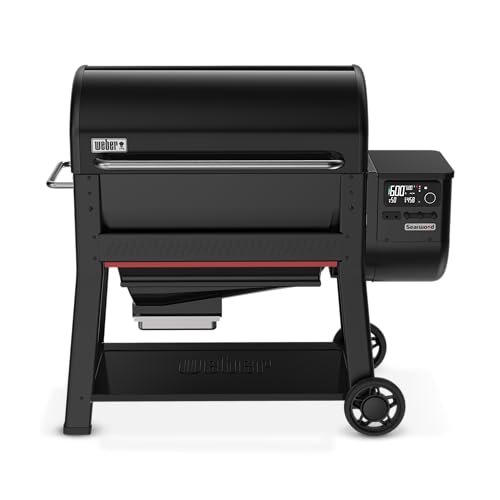
The Weber Searwood XL 600 is the big sibling in Weber’s Searwood pellet line, and it is the one to look at if you regularly cook for more than four or five people. It combines the usual pellet-grill conveniences, such as automatic fuel feed, a digital controller and an app, with a temperature ceiling of 600°F that most pellet grills do not reach. On our site it sits in the premium group, third in our pellet grill ranking for 2026.
A note on method: we do not handle these grills. This profile comes from Weber’s own product page for part number 1500121 and from Weber’s published FAQ. If a number is not on that page, it is not here.
What Weber Publishes
According to Weber, the Searwood XL 600 offers:
- Cooking area: 972 square inches in total. The bottom grate is 630 square inches (36 by 17.5 inches) and the top grate adds 342.
- Capacity: Weber says the grill can handle 21 steaks.
- Temperature range: 180°F to 600°F, described as a full range for smoking and searing.
- Cooking system: DirectFlame cooking, with a full-grate sear zone that puts more food on the flame.
- Controller: the Weber Connect digital LCD controller with Rapid React PID, which Weber says heats the smoker to temperature in 15 minutes or less and recovers quickly after the lid is opened.
- Connectivity: Wi-Fi and Bluetooth through the Weber Connect app, with live cook graphs, readiness alerts and recipes.
- Smoke setting: SmokeBoost, which Weber says holds low smoking temperatures to intensify smoky flavor.
- Manual mode: steady fuel and fan speed for constant heat, intended for griddling or any cook where you want to keep the lid open.
- Dimensions: 45.75 inches high, 50.5 inches wide and 23 inches deep with the lid closed; 59.5 inches high and 28.5 inches deep with the lid open.
- Weight: 157.8 pounds.
Weber also lists a rust-resistant griddle insert that is sold separately and turns the grill into a griddle. Hopper capacity and warranty length are not stated in the product text we read, so check Weber’s warranty page before you buy.
DirectFlame and the Sear Question
Most pellet grills cook with indirect heat. A sheet-metal diffuser sits between the fire pot and the grate, which makes temperatures very even and also limits browning. Weber’s pitch for the Searwood line is that there is no large sheet diffuser blocking the flame, so food gets sear marks, browning and crisping directly from the fire. The “full grate sear zone” language means that, unlike a grill with one small searing section, the whole grate is meant to be usable for browning.
That matters most if you have been disappointed by the pale, soft crust you sometimes get from a pellet smoker. A 600°F ceiling is also higher than the 450 and 500°F maximums that Traeger lists for its Ranger, Tailgater and Timberline. The Timberline takes a different route to searing: Traeger lists a 165 to 500°F range plus a side induction cooktop. See our Traeger Timberline profile.
A caution applies to any high-heat feature. Searing at 600°F produces more grease flare and smoke, and it makes the first few feet around the grill hotter. Keep the grill clean, never leave it unattended at high temperatures, and follow the owner’s manual.
Smoking Low and Slow
The 180°F floor is the other half of the story. A grill that starts at 180°F can run true smoker temperatures for brisket, pork shoulder and ribs, and Weber’s SmokeBoost setting is intended to stretch the smoke-heavy part of a cook. The Rapid React PID controller is the piece that holds the set temperature, adjusting fuel and fan speed as conditions change. Weber says that it also helps the grill regain temperature after you open the lid, which is a common frustration when you check on a long cook.
We would treat the 15-minute preheat as a best-case figure. Weber footnotes it as lab conditions: 77°F ambient and premium hardwood pellets. A cold November afternoon will not match it.
Weber Connect and Remote Control
The Weber Connect app handles monitoring, readiness alerts and recipes, and Weber says you can control the grill remotely once it is running. The safety rule is simple: the grill must be started at the grill. Weber’s FAQ states that you cannot remotely start it, and that after ignition you may adjust it from the app. Weber also says the grill works without Wi-Fi, but that connecting it is best so it can run the latest software and firmware.
For a long overnight smoke, the practical benefit is the alerts. You can stay inside and still know that the grill is up to temperature or that the food is ready to flip. Treat that as a convenience, not a substitute for being nearby. A pellet grill is a fire appliance.
Size, Weight and Where It Fits
At 50.5 inches wide, this grill is a permanent patio resident. It weighs almost 158 pounds, so you will move it once or twice and then leave it. Think about three things before you buy:
- Footprint and clearance. With the lid open the grill is 28.5 inches deep and almost 60 inches tall. Weber’s FAQ recommends at least 2 feet from any walls or structures, and the owner’s manual lists the clearances you must follow.
- Power. Weber says a pellet grill needs an outlet (120V). Place the grill so the cord reaches without being stretched across a walkway.
- Fire rules. Use it outdoors only, never in a garage or under a roof overhang. Seattle Fire Department advises using a grill on a noncombustible surface 10 feet from siding, deck rails and open doors or windows, and the International Fire Code limits open-flame cooking on combustible balconies or within 10 feet of combustible construction, with exceptions. Check local fire code and any HOA or condo rules.
If your patio is small, the Weber Searwood 600 offers the same feature list with 648 square inches and a 38.5-inch-wide cookbox.
Pros and Cons at a Glance
Pros
- The largest grate area of the Weber pair, 972 square inches
- 600°F ceiling with a full-grate sear zone
- A real smoker range from 180°F
- App monitoring with alerts, and a manual mode for lid-open cooking
- Optional griddle insert
Cons
- Heavy and wide, so it is a fixed installation
- Must be lit at the grill
- Needs an outlet, which limits placement
- Premium range, so it is a larger commitment than a mid-range grill
- Hopper size and warranty terms need checking on Weber’s pages
Who Should Buy It
This grill suits a household that cooks for a crowd or likes leftovers from big smokes. It also suits someone who wants one grill to replace a smoker and a gas grill for searing. If you cook for two, a mid-range unit is a better fit. If you want the most compact option, compare the smaller models in our ranking, or look at a portable such as the Grilla Chimp 2.0.
Who Should Look Elsewhere
- Small patios and balconies. The width and clearance requirements are real. Check your building’s rules before you buy any pellet grill.
- Campers and tailgaters. It weighs close to 158 pounds and is not designed to be carried.
- Buyers who want a fixed-cost, set-and-forget grill with no app. The controller works without Wi-Fi, but the app is a big part of the pitch.
- Anyone who must start the cook remotely. Weber does not allow that.
Care and Ownership
Pellet grills need regular cleaning, because grease and ash build up around the burn pot and drip areas. Follow Weber’s manual for cleaning intervals, store pellets in a dry container, and keep the grill covered or protected from weather according to the maker’s guidance. A pellet grill is not an indoor appliance. Use it outdoors only, with the clearances in the manual.
Bottom Line
The Searwood XL 600 is a premium, full-size pellet grill whose main selling points are its 972 square inches, its 600°F ceiling and its DirectFlame sear zone. It asks for space, an outlet and a permanent spot. If those fit, it is one of the more versatile grills in our ranking. See the full comparison in our pellet grill ranking.
See price on Amazon
Sources